Audiobook
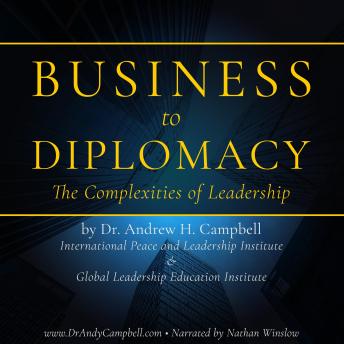
Diplomacy is critically important in leadership as it influences the leader’s ability to effectively navigate the complexities of not only international relations but also tactical, organizational, and strategic business operations. Dr. Andrew Campbell is the Director of the International Peace and Leadership Institute and Director of the Global Leadership Education Institute. As a critically acclaimed author, international speaker, and leadership researcher, he blends global leadership, organizational leadership, international conflict management and terrorism, and emotional intelligence to show that business leadership is missing diplomacy as a key ingredient and that diplomats require leadership knowledge, skills, and abilities to lead in resolving international tensions.
In times of organizational chaos, we look to leaders to guide us with focus, clarity, and calmness. From a global pandemic, economic crisis, and deepening socio-political discourse leaders have faced a constant barrage of chaos and uncertainty. How does a leader deal with turbulent issues in today’s rapid fast-changing environment? How does a leader apply one’s unique leadership composition to the organizational uncertainty and chaos of the day? How do you lead yourself during times of uncertain and complex public and private sector situations?
Peace Leadership: Self-Transformation to Peace
Peace Leadership: Self-Transformation to Peace is a significant contribution to the emerging discipline of peace leadership as the international community, non-governmental organizations, and the public and private sectors struggle to formulate sustainable peace initiatives at an individual, local and communal societal level. It offers a practical framework for all leaders (including business and political leaders) on how to attain peace between people. It reveals emerging research linking global leadership concepts within peace development research. This research is urgently needed for global leadership to understand the leadership role within conflict resolution or peace building practitioners.
Peace Leadership: Self-Transformation to Peace
Peace Leadership: Self-Transformation to Peace is a significant contribution to the emerging discipline of peace leadership as the international community, non-governmental organizations, and the public and private sectors struggle to formulate sustainable peace initiatives at an individual, local and communal societal level. It offers a practical framework for all leaders (including business and political leaders) on how to attain peace between people. It reveals emerging research linking global leadership concepts within peace development research. This research is urgently needed for global leadership to understand the leadership role within conflict resolution or peace building practitioners.
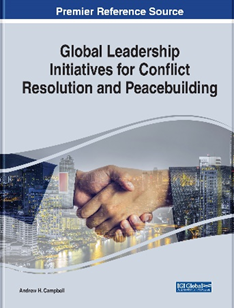
Global Leadership Initiatives for Conflict Resolution and Peace buildin
Foreword by Lawrence Olufemi Obisakin the Ambassador of the Federal
Republic of Nigeria to the Republic of Benin
One global leadership challenge is managing the complexity of the political and economic climate of a society. As the global environment changes, global leaders need to adapt and develop flexible strategies for resolving conflicts and achieving peace.
Global Leadership Initiatives for Conflict Resolution and Peace building provides emerging research on a leader’s role in the international, national, and nongovernmental organization within post-conflict resolution and peaceful leadership. While highlighting topics, such as civil society organizations, leadership education, and social reconstruction, this book explores leadership theories and practice models to conceptualize the intersection of leadership within conflict management and resolution. This book is an important resource for leaders, scholar-practitioners, educators, and researchers seeking current research on the strategic and diplomatic methods of a peaceful global organization.